$80,000 after taxes in Virginia at a glance
| Pay period | Take-home pay |
|---|---|
| Per year | 61,271 |
| Per month | 5,106 |
| Per biweekly paycheck | 2,357 |
| Per week | 1,178.29 |
| Per hour (2,080-hour year) | 29.46 |
Where your $80,000 goes: the 2026 deductions
| Deduction | Amount per year |
|---|---|
| Gross salary | $80,000 |
| Federal income tax (after standard deduction) | −8,770 |
| Social Security (6.2%) | −4,960 |
| Medicare (1.45%) | −1,160 |
| Virginia state income tax | −3,839 |
| Take-home pay | 61,271 |
How Virginia income tax works in 2026
The versioned 2026 model uses Virginia’s progressive schedule, with the 5.75% top rate applying to the last dollars earned at this salary. Virginia levies no local income taxes, so the state line on your payslip is the whole state story. At $80,000, modeled state deductions are about 3,839 (4.8% of gross).
At $80,000, the federal bracket changes in Virginia
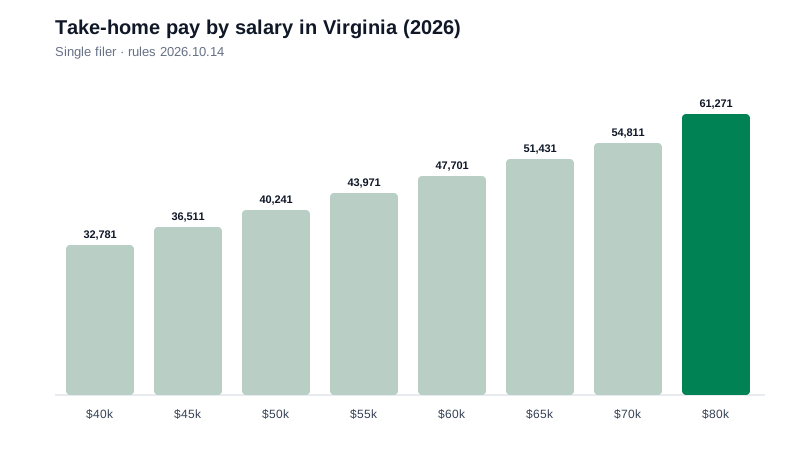
$80,000 in Virginia keeps $61,271 — $5,106 a month — after $8,770 of federal tax, $6,120 of FICA and $3,839 to the state. The quiet headline is in the federal line: this salary is the first in this series whose top dollars enter the 22% federal bracket instead of the 12% one.
Your marginal rate just jumped
Below roughly $66,500 of gross salary, additional dollars cost 12% federal + 7.65% FICA + 5.75% Virginia — about 74 cents kept. Above it, the top slice pays 22% federal, and the same stack keeps about 65 cents. Raises and bonuses from here on arrive at the higher rate, which is exactly why higher earners in Virginia lean harder on pre-tax deferrals.
The deferral window, wide open
A traditional 401(k) or HSA contribution at $80,000 reduces income taxed at 22% + 5.75% — the strongest tax leverage available in this series. A $400 monthly deferral cuts combined withholding by roughly $110 while adding the employer match and the compounding decades ahead.
NoVA versus the rest, at scale
$80,000 is a strong single salary in Richmond or Norfolk and a tight one in Arlington; the household version of that sentence is why much of Virginia’s mid-career population lives west of the Capital Beltway and commutes in. The no-local-tax structure keeps the entire calculation transparent wherever you land.
More salaries after tax in Virginia
- $40,000 after tax in Virginia
- $45,000 after tax in Virginia
- $50,000 after tax in Virginia
- $55,000 after tax in Virginia
- $60,000 after tax in Virginia
- $65,000 after tax in Virginia
- $70,000 after tax in Virginia
- See the full Virginia paycheck calculator
$80,000 after tax in other states
- $80,000 after tax in California
- $80,000 after tax in Illinois
- $80,000 after tax in Michigan
- $80,000 after tax in Texas
- $80,000 after tax in Florida
- $80,000 after tax in New York
- $80,000 after tax in Pennsylvania
- $80,000 after tax in North Carolina
Frequently asked questions
What is $80,000 after taxes in Virginia?
About 61,271 a year or 5,106 a month for this standard single-filer 2026 estimate.
How much is that per month?
Approximately 5,106 per month, based on annual take-home divided by 12.
How much is that biweekly?
Approximately 2,357 across 26 pay periods.
What is the after-tax hourly rate?
About $29.46 per hour on a 2,080-hour work year.
Does $80,000 push me into a higher tax bracket?
Federally, yes: the top dollars of an $80,000 salary enter the 22% federal bracket (roughly $8,770 total federal tax). The Virginia state treatment is described above and applies at every salary level.
How does Virginia compare to other states at $80,000?
The state tax of 3,839 is the only difference versus most of the country — a zero-tax state such as Texas keeps about 3,839 more of the same salary.