$70,000 after taxes in Virginia at a glance
| Pay period | Take-home pay |
|---|---|
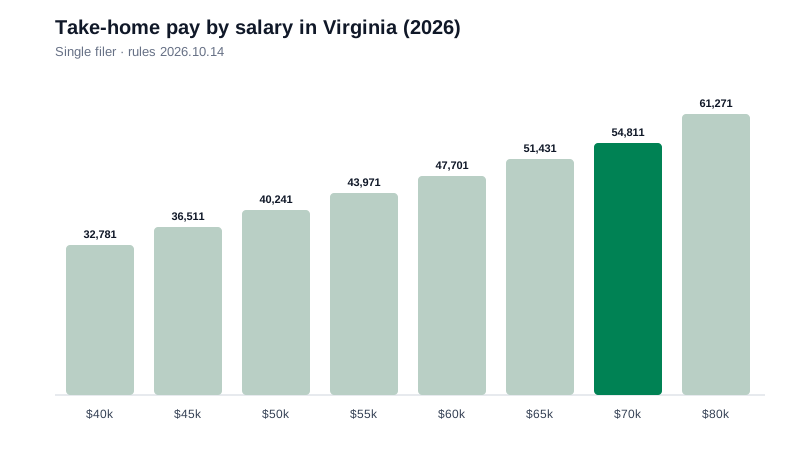
| Per year | 54,811 |
| Per month | 4,568 |
| Per biweekly paycheck | 2,108 |
| Per week | 1,054.06 |
| Per hour (2,080-hour year) | 26.35 |
Where your $70,000 goes: the 2026 deductions
| Deduction | Amount per year |
|---|---|
| Gross salary | $70,000 |
| Federal income tax (after standard deduction) | −6,570 |
| Social Security (6.2%) | −4,340 |
| Medicare (1.45%) | −1,015 |
| Virginia state income tax | −3,264 |
| Take-home pay | 54,811 |
How Virginia income tax works in 2026
The versioned 2026 model uses Virginia’s progressive schedule, with the 5.75% top rate applying to the last dollars earned at this salary. Virginia levies no local income taxes, so the state line on your payslip is the whole state story. At $70,000, modeled state deductions are about 3,264 (4.7% of gross).
What $70,000 builds in Virginia
At $70,000 — $54,811 after the deductions above — Virginia earners cross into the territory where planning beats budgeting. The state takes $3,264, the federal schedule takes $6,570, FICA takes $5,355, and everything after that is a decision rather than a constraint.
Mortgage math on a Virginia salary
Lenders typically offer around 4.5 times gross salary, which puts a $70,000 earner near $315,000 of borrowing before the deposit. That qualifies for a solid single-family home in much of Richmond, the Shenandoah Valley or Hampton Roads — markets where the same income would struggle in close-in NoVA. It is one of the clearest cases in the country where the state you live in matters more than the salary you earn.
The marginal rate on your next dollar
Your top dollars are taxed at Virginia’s full 5.75%, inside the federal 12% bracket, with 7.65% FICA beneath — roughly 26 cents per additional dollar. Raises and bonuses all arrive at that rate until the federal 22% bracket begins at higher incomes, so the years between $70,000 and the low six figures are the cheapest earning years of your career in Virginia terms.
The retirement trade Virginia offers
Virginia does not tax Social Security benefits and exempts much retirement-plan income for seniors — meaning today’s 5.75% on wages converts to a far lighter state bill in retirement. Aggressive 401(k) saving at $70,000 both cuts the current bill and pre-loads the lighter one, a combination that flatters long-horizon savers more than most high-tax states.
More salaries after tax in Virginia
- $40,000 after tax in Virginia
- $45,000 after tax in Virginia
- $50,000 after tax in Virginia
- $55,000 after tax in Virginia
- $60,000 after tax in Virginia
- $65,000 after tax in Virginia
- $80,000 after tax in Virginia
- See the full Virginia paycheck calculator
$70,000 after tax in other states
- $70,000 after tax in California
- $70,000 after tax in Illinois
- $70,000 after tax in Michigan
- $70,000 after tax in Texas
- $70,000 after tax in Florida
- $70,000 after tax in New York
- $70,000 after tax in Pennsylvania
- $70,000 after tax in North Carolina
Frequently asked questions
What is $70,000 after taxes in Virginia?
About 54,811 a year or 4,568 a month for this standard single-filer 2026 estimate.
How much is that per month?
Approximately 4,568 per month, based on annual take-home divided by 12.
How much is that biweekly?
Approximately 2,108 across 26 pay periods.
What is the after-tax hourly rate?
About $26.35 per hour on a 2,080-hour work year.
Does Virginia have local income tax?
No. Virginia state payroll withholding is the only income tax on wages — unlike Pennsylvania or Michigan, no Virginia city or county adds its own layer.
How does Virginia compare to other states at $70,000?
The state tax of 3,264 is the only difference versus most of the country — a zero-tax state such as Texas keeps about 3,264 more of the same salary.