$60,000 after taxes in Virginia at a glance
| Pay period | Take-home pay |
|---|---|
| Per year | 47,701 |
| Per month | 3,975 |
| Per biweekly paycheck | 1,835 |
| Per week | 917.33 |
| Per hour (2,080-hour year) | 22.93 |
Where your $60,000 goes: the 2026 deductions
| Deduction | Amount per year |
|---|---|
| Gross salary | $60,000 |
| Federal income tax (after standard deduction) | −5,020 |
| Social Security (6.2%) | −3,720 |
| Medicare (1.45%) | −870 |
| Virginia state income tax | −2,689 |
| Take-home pay | 47,701 |
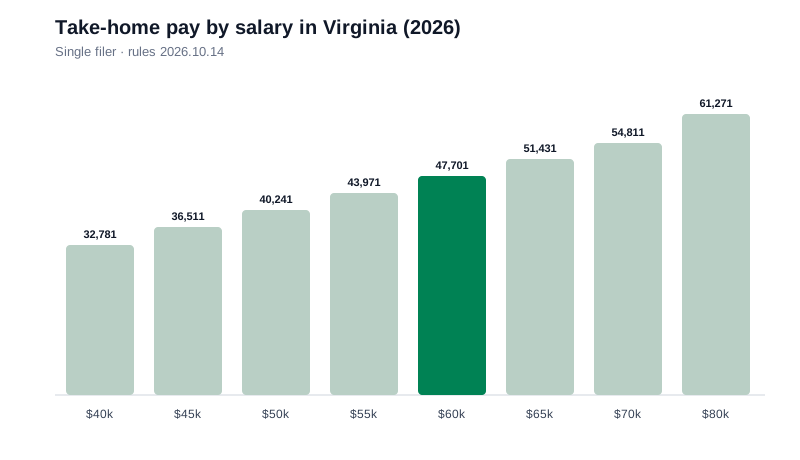
How Virginia income tax works in 2026
The versioned 2026 model uses Virginia’s progressive schedule, with the 5.75% top rate applying to the last dollars earned at this salary. Virginia levies no local income taxes, so the state line on your payslip is the whole state story. At $60,000, modeled state deductions are about 2,689 (4.5% of gross).
The commuter’s calculation at $60,000
$60,000 in Virginia is the salary of the border: live in Arlington and work in DC, live in Fairfax and work in Tysons, or stay remote for a Richmond employer. The table above settles the state side — $47,701 after Virginia’s $2,689 share — but the real decision most people at this income run is which side of a state line to sleep on.
Virginia versus the District, in one number
Virginia’s top rate of 5.75% caps out at a modest income, while DC’s schedule climbs toward 10.75% far above it. At $60,000 the difference is worth roughly a thousand dollars a year of state-level tax — before housing costs enter the comparison. For most NoVA commuters the wage premium and the rent premium decide the rest; the tax line alone is close to a car payment.
Withholding follows you across the border
Virginia withholds based on where you live, not where you work, and reciprocity agreements handle the edge cases at filing. If you moved between states mid-year, each employer’s withholding only saw part of your year — the April reconciliation is where the full-year brackets are finally applied. Set aside part of any final-quarter bonus if you switched jobs across a state line this year.
What $3,975 a month funds
Monthly take-home of $3,975 supports a comfortable single life anywhere in Virginia outside close-in Arlington: a good apartment in Richmond or Norfolk, a reliable car, and a real savings habit. As a dual-income household’s second salary, it changes the childcare-versus-work equation entirely.
More salaries after tax in Virginia
- $40,000 after tax in Virginia
- $45,000 after tax in Virginia
- $50,000 after tax in Virginia
- $55,000 after tax in Virginia
- $65,000 after tax in Virginia
- $70,000 after tax in Virginia
- $80,000 after tax in Virginia
- See the full Virginia paycheck calculator
$60,000 after tax in other states
- $60,000 after tax in California
- $60,000 after tax in Illinois
- $60,000 after tax in Michigan
- $60,000 after tax in Texas
- $60,000 after tax in Florida
- $60,000 after tax in New York
- $60,000 after tax in Pennsylvania
- $60,000 after tax in North Carolina
Frequently asked questions
What is $60,000 after taxes in Virginia?
About 47,701 a year or 3,975 a month for this standard single-filer 2026 estimate.
How much is that per month?
Approximately 3,975 per month, based on annual take-home divided by 12.
How much is that biweekly?
Approximately 1,835 across 26 pay periods.
What is the after-tax hourly rate?
About $22.93 per hour on a 2,080-hour work year.
Does Virginia have local income tax?
No. Virginia state payroll withholding is the only income tax on wages — unlike Pennsylvania or Michigan, no Virginia city or county adds its own layer.
How does Virginia compare to other states at $60,000?
The state tax of 2,689 is the only difference versus most of the country — a zero-tax state such as Texas keeps about 2,689 more of the same salary.