$45,000 after taxes in Minnesota at a glance
| Pay period | Take-home pay |
|---|---|
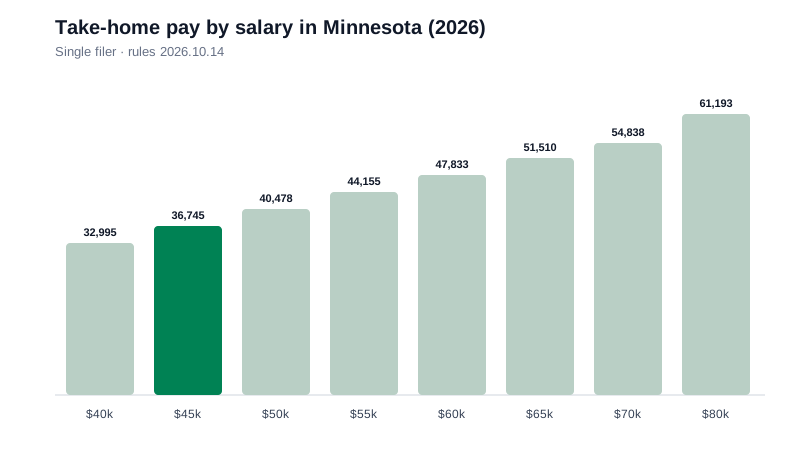
| Per year | 36,745 |
| Per month | 3,062 |
| Per biweekly paycheck | 1,413 |
| Per week | 706.63 |
| Per hour (2,080-hour year) | 17.67 |
Where your $45,000 goes: the 2026 deductions
| Deduction | Amount per year |
|---|---|
| Gross salary | $45,000 |
| Federal income tax (after standard deduction) | −3,220 |
| Social Security (6.2%) | −2,790 |
| Medicare (1.45%) | −653 |
| Minnesota state income tax | −1,592 |
| Take-home pay | 36,745 |
How Minnesota income tax works in 2026
The versioned 2026 model uses Minnesota’s progressive schedule, whose top rate reaches 9.85% at high incomes. Minnesota cities levy no local income tax — whatever cities collect comes from property and sales taxes instead. At $45,000, modeled state deductions are about 1,592 (3.5% of gross).
$45,000: still in the 5.35% band, with the next band visible
At $45,000, Minnesota’s taxable base is about $29,770 — still inside the 5.35% lowest band, which ends at $33,570 of taxable income. The state line is $1,592, and the next bracket is close enough to see from here: gross salaries beyond roughly $48,800 begin paying 6.8% on the dollars above that line.
Planning around a visible threshold
Knowing where the 6.8% band starts turns an abstract raise into a concrete decision. A raise from $45,000 to $50,000 crosses the line — the extra dollars above it are taxed 1.45 points higher by the state, a real but modest cost that never re-taxes the income beneath it. This is the bracket mechanics that progressive states ask every earner to learn, and Minnesota’s version is unusually legible.
Where $3,062 a month lands
Take-home of $3,062 a month funds a genuine adult life in the Twin Cities: a good shared place or modest solo apartment, transit-optional living, and the beginnings of the savings habit the higher bands will later test. The no-local-tax structure keeps the budget arithmetic honest from Maple Grove to St. Paul.
More salaries after tax in Minnesota
- $40,000 after tax in Minnesota
- $50,000 after tax in Minnesota
- $55,000 after tax in Minnesota
- $60,000 after tax in Minnesota
- $65,000 after tax in Minnesota
- $70,000 after tax in Minnesota
- $80,000 after tax in Minnesota
- See the full Minnesota paycheck calculator
$45,000 after tax in other states
- $45,000 after tax in California
- $45,000 after tax in Illinois
- $45,000 after tax in Michigan
- $45,000 after tax in Texas
- $45,000 after tax in Florida
- $45,000 after tax in New York
- $45,000 after tax in Pennsylvania
- $45,000 after tax in North Carolina
Frequently asked questions
What is $45,000 after taxes in Minnesota?
About 36,745 a year or 3,062 a month for this standard single-filer 2026 estimate.
How much is that per month?
Approximately 3,062 per month, based on annual take-home divided by 12.
How much is that biweekly?
Approximately 1,413 across 26 pay periods.
What is the after-tax hourly rate?
About $17.67 per hour on a 2,080-hour work year.
How much federal tax is taken from $45,000?
About $3,220 for a single filer in 2026 — computed after the $16,100 standard deduction, with the 10% and 12% brackets doing the work.
How does Minnesota compare to other states at $45,000?
The state tax of 1,592 is the only difference versus most of the country — a zero-tax state such as Texas keeps about 1,592 more of the same salary.