$80,000 after taxes in Minnesota at a glance
| Pay period | Take-home pay |
|---|---|
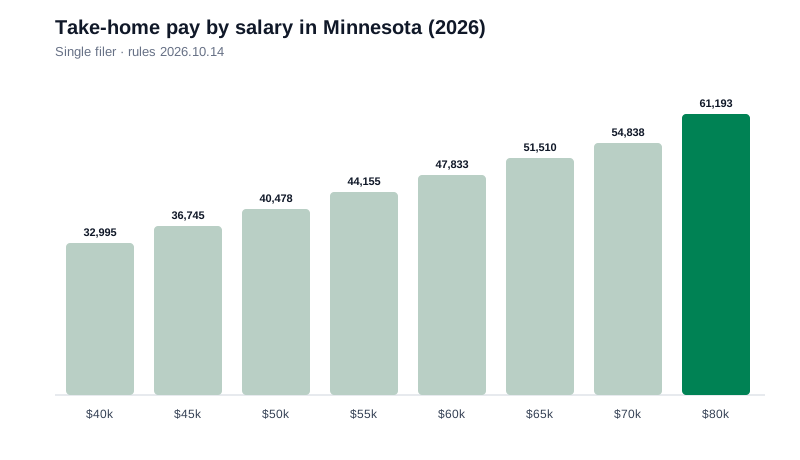
| Per year | 61,193 |
| Per month | 5,099 |
| Per biweekly paycheck | 2,354 |
| Per week | 1,176.79 |
| Per hour (2,080-hour year) | 29.42 |
Where your $80,000 goes: the 2026 deductions
| Deduction | Amount per year |
|---|---|
| Gross salary | $80,000 |
| Federal income tax (after standard deduction) | −8,770 |
| Social Security (6.2%) | −4,960 |
| Medicare (1.45%) | −1,160 |
| Minnesota state income tax | −3,917 |
| Take-home pay | 61,193 |
How Minnesota income tax works in 2026
The versioned 2026 model uses Minnesota’s progressive schedule, whose top rate reaches 9.85% at high incomes. Minnesota cities levy no local income tax — whatever cities collect comes from property and sales taxes instead. At $80,000, modeled state deductions are about 3,917 (4.9% of gross).
The 9.85% question at $80,000 — answered
Minnesota’s top rate gets talked about, so the table above deserves a plain reading: at $80,000, none of your income touches the 9.85% band or even the 7.85% one. Taxable income of about $64,770 sits entirely inside the 6.8% middle band, producing $3,917 of state tax — an effective 4.9% of gross.
The top band is far away — the federal one is not
Two bracket facts matter at $80,000. Minnesota’s higher bands begin far above this salary, so the state rate holds steady on the climb ahead. The federal 22% bracket, though, starts around $66,500 of gross — top dollars at this salary already pay it. The result: raises keep about 73 cents on the dollar, and the strongest lever is a traditional 401(k) or HSA deferral, which reduces income taxed at 22% + 6.8% — nearly 29 cents of immediate relief per dollar.
The relocation comparison, quantified
Against Texas at $80,000, Minnesota’s state line is $3,917 — the size of a maxed Roth IRA contribution plus change. What the number buys is the metro’s amenity set at housing costs well below coastal peers; what it costs is visible monthly on the payslip. At this income, that trade is finally a genuine decision rather than a constraint.
More salaries after tax in Minnesota
- $40,000 after tax in Minnesota
- $45,000 after tax in Minnesota
- $50,000 after tax in Minnesota
- $55,000 after tax in Minnesota
- $60,000 after tax in Minnesota
- $65,000 after tax in Minnesota
- $70,000 after tax in Minnesota
- See the full Minnesota paycheck calculator
$80,000 after tax in other states
- $80,000 after tax in California
- $80,000 after tax in Illinois
- $80,000 after tax in Michigan
- $80,000 after tax in Texas
- $80,000 after tax in Florida
- $80,000 after tax in New York
- $80,000 after tax in Pennsylvania
- $80,000 after tax in North Carolina
Frequently asked questions
What is $80,000 after taxes in Minnesota?
About 61,193 a year or 5,099 a month for this standard single-filer 2026 estimate.
How much is that per month?
Approximately 5,099 per month, based on annual take-home divided by 12.
How much is that biweekly?
Approximately 2,354 across 26 pay periods.
What is the after-tax hourly rate?
About $29.42 per hour on a 2,080-hour work year.
Does $80,000 push me into a higher tax bracket?
Federally, yes: the top dollars of an $80,000 salary enter the 22% federal bracket (roughly $8,770 total federal tax). The Minnesota state treatment is described above and applies at every salary level.
How does Minnesota compare to other states at $80,000?
The state tax of 3,917 is the only difference versus most of the country — a zero-tax state such as Texas keeps about 3,917 more of the same salary.