$70,000 after taxes in Minnesota at a glance
| Pay period | Take-home pay |
|---|---|
| Per year | 54,838 |
| Per month | 4,570 |
| Per biweekly paycheck | 2,109 |
| Per week | 1,054.58 |
| Per hour (2,080-hour year) | 26.36 |
Where your $70,000 goes: the 2026 deductions
| Deduction | Amount per year |
|---|---|
| Gross salary | $70,000 |
| Federal income tax (after standard deduction) | −6,570 |
| Social Security (6.2%) | −4,340 |
| Medicare (1.45%) | −1,015 |
| Minnesota state income tax | −3,237 |
| Take-home pay | 54,838 |
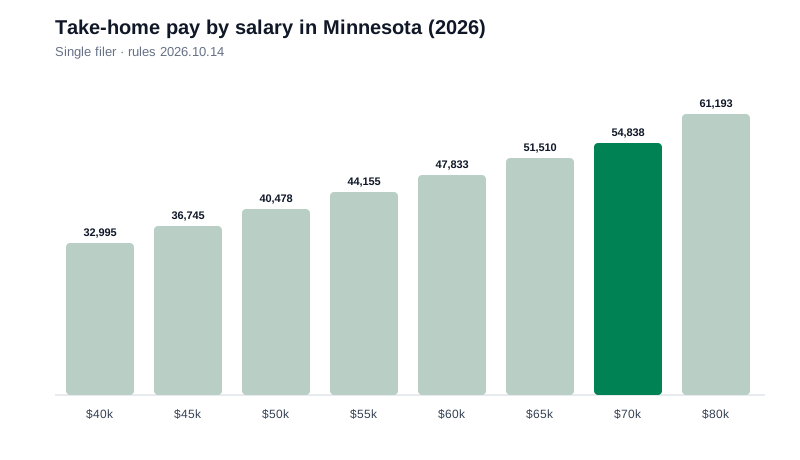
How Minnesota income tax works in 2026
The versioned 2026 model uses Minnesota’s progressive schedule, whose top rate reaches 9.85% at high incomes. Minnesota cities levy no local income tax — whatever cities collect comes from property and sales taxes instead. At $70,000, modeled state deductions are about 3,237 (4.6% of gross).
At $70,000, Minnesota’s upper brackets arrive
The $70,000 salary in the table above carries a $3,237 Minnesota state line — meaningfully more than Indiana’s flat $2,036 or Arizona’s $1,356 on the same gross. The progressive schedule is doing what progressive schedules do: at this income your last dollars are taxed in the upper-middle bands, and the marginal cost of earning more is rising with you.
What the higher state bill buys back
Minnesota’s higher income tax funds the systems residents actually use — no local wage taxes, strong public services, and a metro whose amenity level punches far above its housing costs. At $54,838 of annual take-home, $4,570 a month funds a good one-bedroom in most of Minneapolis–St. Paul, a funded 401(k) match and a genuine vacation budget. The honest framing for a $70,000 offer in Minnesota: the state line is the price of the quality of life, and it is visible every month on the payslip.
The deferral lever, worth more here
Because Minnesota’s brackets are engaged at this salary, traditional 401(k) and HSA contributions reduce income that would otherwise be taxed in the upper-middle state bands. A $500-a-month deferral at $70,000 cuts combined withholding by roughly $100 — more than the same election saves in a flat-tax state, and the gap widens as salaries climb toward the 9.85% ceiling.
The comparison relocators actually run
The usual Minnesota comparison is Texas or Arizona, where the state column reads zero or near-zero. At $70,000 the difference approaches $3,200 a year — serious money, and the number to weigh against the wage premium and the housing discount the Twin Cities offer relative to coastal metros of the same size.
More salaries after tax in Minnesota
- $40,000 after tax in Minnesota
- $45,000 after tax in Minnesota
- $50,000 after tax in Minnesota
- $55,000 after tax in Minnesota
- $60,000 after tax in Minnesota
- $65,000 after tax in Minnesota
- $80,000 after tax in Minnesota
- See the full Minnesota paycheck calculator
$70,000 after tax in other states
- $70,000 after tax in California
- $70,000 after tax in Illinois
- $70,000 after tax in Michigan
- $70,000 after tax in Texas
- $70,000 after tax in Florida
- $70,000 after tax in New York
- $70,000 after tax in Pennsylvania
- $70,000 after tax in North Carolina
Frequently asked questions
What is $70,000 after taxes in Minnesota?
About 54,838 a year or 4,570 a month for this standard single-filer 2026 estimate.
How much is that per month?
Approximately 4,570 per month, based on annual take-home divided by 12.
How much is that biweekly?
Approximately 2,109 across 26 pay periods.
What is the after-tax hourly rate?
About $26.36 per hour on a 2,080-hour work year.
Does Minnesota have local income tax?
No. Minneapolis and St. Paul do not tax wages — city revenue comes from property and sales taxes, so the state line on your payslip is the entire income-tax picture.
How does Minnesota compare to other states at $70,000?
The state tax of 3,237 is the only difference versus most of the country — a zero-tax state such as Texas keeps about 3,237 more of the same salary.