$60,000 after taxes in Minnesota at a glance
| Pay period | Take-home pay |
|---|---|
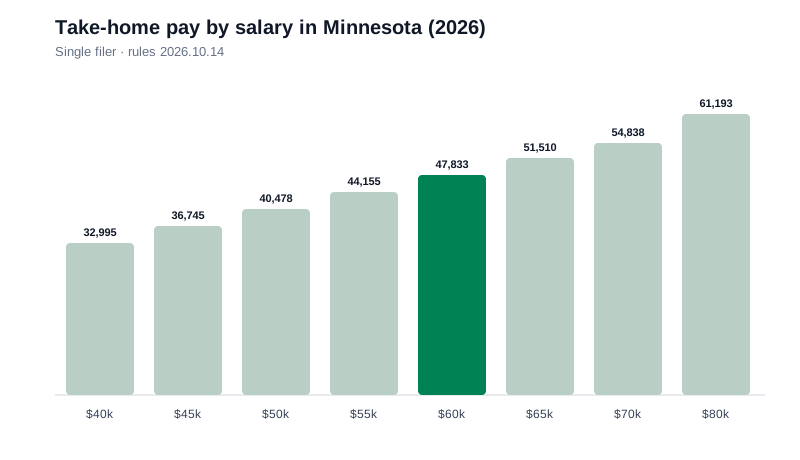
| Per year | 47,833 |
| Per month | 3,986 |
| Per biweekly paycheck | 1,840 |
| Per week | 919.87 |
| Per hour (2,080-hour year) | 23.00 |
Where your $60,000 goes: the 2026 deductions
| Deduction | Amount per year |
|---|---|
| Gross salary | $60,000 |
| Federal income tax (after standard deduction) | −5,020 |
| Social Security (6.2%) | −3,720 |
| Medicare (1.45%) | −870 |
| Minnesota state income tax | −2,557 |
| Take-home pay | 47,833 |
How Minnesota income tax works in 2026
The versioned 2026 model uses Minnesota’s progressive schedule, whose top rate reaches 9.85% at high incomes. Minnesota cities levy no local income tax — whatever cities collect comes from property and sales taxes instead. At $60,000, modeled state deductions are about 2,557 (4.3% of gross).
Living on $60,000 in the Twin Cities
$60,000 in Minnesota produces $47,833 of take-home in the standard model above — $3,986 a month, $1,840 biweekly. The state’s share is $2,557, reflecting a schedule whose upper-middle brackets are already engaged at this salary. What the numbers do not show is that the Twin Cities deliver one of the best quality-of-life returns on this income of any major metro in the country.
The seasonal budget reality
Minnesota budgeting runs hot and cold by design: summer months carry the travel, lake weekends and patio season; January carries the utility peak, the parking garage line and the indoor-entertainment budget. A disciplined year at $3,986 a month sets aside the winter premium in advance rather than discovering it in the first big heating bill.
The Wisconsin border comparison
Minnesotans near the border weigh Madison and Eau Claire offers against Twin Cities ones. Wisconsin’s schedule runs lower at the top end than Minnesota’s 9.85% ceiling, but at $60,000 the practical state-tax difference is measured in hundreds of dollars a year — small enough that the job market, which strongly favours the Twin Cities at this salary level, should decide the question on its own.
Your marginal stack at $60,000
Add the federal 12% bracket and the 7.65% FICA pair to Minnesota’s engaged middle brackets and each additional dollar keeps roughly 73 cents. That is the moderate-tax reality of the state — higher than the flat South, lower than the coasts — and the standard pre-tax levers (401(k), HSA, commuter accounts) work against both layers simultaneously.
More salaries after tax in Minnesota
- $40,000 after tax in Minnesota
- $45,000 after tax in Minnesota
- $50,000 after tax in Minnesota
- $55,000 after tax in Minnesota
- $65,000 after tax in Minnesota
- $70,000 after tax in Minnesota
- $80,000 after tax in Minnesota
- See the full Minnesota paycheck calculator
$60,000 after tax in other states
- $60,000 after tax in California
- $60,000 after tax in Illinois
- $60,000 after tax in Michigan
- $60,000 after tax in Texas
- $60,000 after tax in Florida
- $60,000 after tax in New York
- $60,000 after tax in Pennsylvania
- $60,000 after tax in North Carolina
Frequently asked questions
What is $60,000 after taxes in Minnesota?
About 47,833 a year or 3,986 a month for this standard single-filer 2026 estimate.
How much is that per month?
Approximately 3,986 per month, based on annual take-home divided by 12.
How much is that biweekly?
Approximately 1,840 across 26 pay periods.
What is the after-tax hourly rate?
About $23.00 per hour on a 2,080-hour work year.
Does Minnesota have local income tax?
No. Minneapolis and St. Paul do not tax wages — city revenue comes from property and sales taxes, so the state line on your payslip is the entire income-tax picture.
How does Minnesota compare to other states at $60,000?
The state tax of 2,557 is the only difference versus most of the country — a zero-tax state such as Texas keeps about 2,557 more of the same salary.