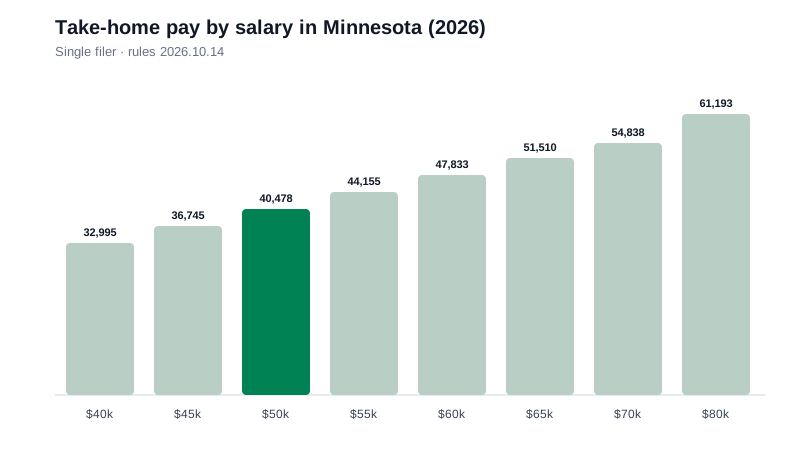
$50,000 after taxes in Minnesota at a glance
| Pay period | Take-home pay |
|---|---|
| Per year | 40,478 |
| Per month | 3,373 |
| Per biweekly paycheck | 1,557 |
| Per week | 778.42 |
| Per hour (2,080-hour year) | 19.46 |
Where your $50,000 goes: the 2026 deductions
| Deduction | Amount per year |
|---|---|
| Gross salary | $50,000 |
| Federal income tax (after standard deduction) | −3,820 |
| Social Security (6.2%) | −3,100 |
| Medicare (1.45%) | −725 |
| Minnesota state income tax | −1,877 |
| Take-home pay | 40,478 |
How Minnesota income tax works in 2026
The versioned 2026 model uses Minnesota’s progressive schedule, whose top rate reaches 9.85% at high incomes. Minnesota cities levy no local income tax — whatever cities collect comes from property and sales taxes instead. At $50,000, modeled state deductions are about 1,877 (3.8% of gross).
Minnesota’s brackets, read at $50,000
Minnesota is a genuinely progressive-tax state — its schedule runs from 5.35% to 9.85% — which is why a $50,000 salary already carries a $1,877 state line in the table above. The effective state rate works out to 3.8% because the lower brackets absorb the first bands of income, but the direction matters more than the average: in Minnesota, unlike the flat-tax states surrounding it, each additional dollar costs more than the one before.
The good news: no local layer
Minneapolis and St. Paul do not tax wages. Whatever the cities collect comes from property and sales taxes, so the state line on your payslip is the entire income-tax picture — a genuine advantage over Pennsylvania-style systems where the municipality adds its own slice, and it partially explains how a high-rate state keeps its total burden moderate.
Where $40,478 lands in the Twin Cities
Annual take-home of $40,478 — $3,373 a month — funds a comfortable shared apartment in most Minneapolis neighbourhoods, a modest one-bedroom further out, and a real savings habit with the light rail and bike infrastructure replacing a car payment for many residents. The winters concentrate spending: budgeting in Minnesota runs in seasons, with the cold-weather months carrying the year’s utility peaks.
The lever that works against the top brackets
Minnesota taxes the same income base the federal system taxes, so traditional 401(k) deferrals cut both bills at once. At $50,000 that leverage is strongest for earners planning to cross into the upper brackets later: every dollar deferred now escapes both today’s 5.35%–7% band and the higher state rates waiting at future salaries.
More salaries after tax in Minnesota
- $40,000 after tax in Minnesota
- $45,000 after tax in Minnesota
- $55,000 after tax in Minnesota
- $60,000 after tax in Minnesota
- $65,000 after tax in Minnesota
- $70,000 after tax in Minnesota
- $80,000 after tax in Minnesota
- See the full Minnesota paycheck calculator
$50,000 after tax in other states
- $50,000 after tax in California
- $50,000 after tax in Illinois
- $50,000 after tax in Michigan
- $50,000 after tax in Texas
- $50,000 after tax in Florida
- $50,000 after tax in New York
- $50,000 after tax in Pennsylvania
- $50,000 after tax in North Carolina
Frequently asked questions
What is $50,000 after taxes in Minnesota?
About 40,478 a year or 3,373 a month for this standard single-filer 2026 estimate.
How much is that per month?
Approximately 3,373 per month, based on annual take-home divided by 12.
How much is that biweekly?
Approximately 1,557 across 26 pay periods.
What is the after-tax hourly rate?
About $19.46 per hour on a 2,080-hour work year.
Does Minnesota have local income tax?
No. Minneapolis and St. Paul do not tax wages — city revenue comes from property and sales taxes, so the state line on your payslip is the entire income-tax picture.
How does Minnesota compare to other states at $50,000?
The state tax of 1,877 is the only difference versus most of the country — a zero-tax state such as Texas keeps about 1,877 more of the same salary.