$65,000 after taxes in Minnesota at a glance
| Pay period | Take-home pay |
|---|---|
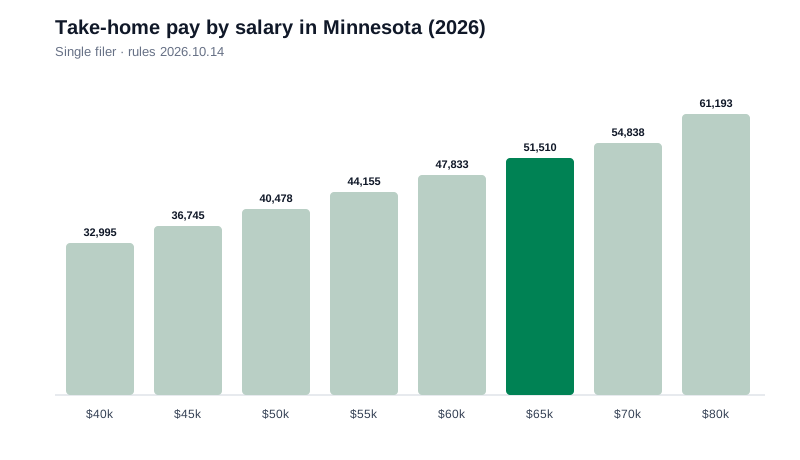
| Per year | 51,510 |
| Per month | 4,292 |
| Per biweekly paycheck | 1,981 |
| Per week | 990.58 |
| Per hour (2,080-hour year) | 24.76 |
Where your $65,000 goes: the 2026 deductions
| Deduction | Amount per year |
|---|---|
| Gross salary | $65,000 |
| Federal income tax (after standard deduction) | −5,620 |
| Social Security (6.2%) | −4,030 |
| Medicare (1.45%) | −943 |
| Minnesota state income tax | −2,897 |
| Take-home pay | 51,510 |
How Minnesota income tax works in 2026
The versioned 2026 model uses Minnesota’s progressive schedule, whose top rate reaches 9.85% at high incomes. Minnesota cities levy no local income tax — whatever cities collect comes from property and sales taxes instead. At $65,000, modeled state deductions are about 2,897 (4.5% of gross).
$65,000 in the Twin Cities
$65,000 in Minnesota produces $51,510 of take-home — $4,293 a month — with the state taking $2,897 through its engaged middle band. It is the salary at which the metro’s famous quality-of-life math starts working in your favour.
What the state bill buys
Minnesota’s income tax funds the systems residents point to when defending it: no local wage taxes, a metro whose parks and transit outperform its housing costs, and public services that show up in everyday life. At $4,293 a month, a good one-bedroom in most of Minneapolis–St. Paul, a funded employer match and a real vacation budget all coexist — the honest framing being that the state line is the visible price of the rest.
The deferral lever, stronger each year
At $65,000 every deferred dollar escapes 12% federal + 6.8% state. A $500-a-month 401(k) deferral cuts withholding by roughly $94 — and unlike the flat-tax states, Minnesota’s brackets rise ahead of your salary, so the same deferral is worth progressively more as income grows toward the 7.85% and 9.85% bands.
The Wisconsin question
Border residents weigh Madison and Eau Claire against the Twin Cities. At $65,000 the state-tax difference is a few hundred dollars a year — and the metro’s deeper job market has quietly answered the question for most mid-career professionals.
More salaries after tax in Minnesota
- $40,000 after tax in Minnesota
- $45,000 after tax in Minnesota
- $50,000 after tax in Minnesota
- $55,000 after tax in Minnesota
- $60,000 after tax in Minnesota
- $70,000 after tax in Minnesota
- $80,000 after tax in Minnesota
- See the full Minnesota paycheck calculator
$65,000 after tax in other states
- $65,000 after tax in California
- $65,000 after tax in Illinois
- $65,000 after tax in Michigan
- $65,000 after tax in Texas
- $65,000 after tax in Florida
- $65,000 after tax in New York
- $65,000 after tax in Pennsylvania
- $65,000 after tax in North Carolina
Frequently asked questions
What is $65,000 after taxes in Minnesota?
About 51,510 a year or 4,292 a month for this standard single-filer 2026 estimate.
How much is that per month?
Approximately 4,292 per month, based on annual take-home divided by 12.
How much is that biweekly?
Approximately 1,981 across 26 pay periods.
What is the after-tax hourly rate?
About $24.76 per hour on a 2,080-hour work year.
How much is $65,000 a month in Minnesota?
About $5,417 gross per month, or 4,292 per month after federal tax, FICA and Minnesota state income tax in this standard 2026 estimate.
How does Minnesota compare to other states at $65,000?
The state tax of 2,897 is the only difference versus most of the country — a zero-tax state such as Texas keeps about 2,897 more of the same salary.