Mortgage borrowing on a £25,000 salary at a glance
| Income multiple | Max borrowing | Monthly payment (25yr, 4.5%) |
|---|---|---|
| 4x income (conservative) | £100,000 | £556 |
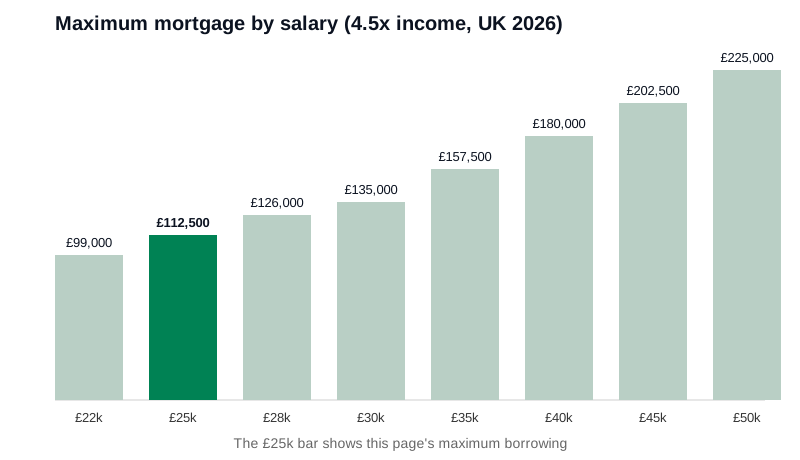
| 4.5x income (typical max) | £112,500 | £625 |
| 5x income (some lenders, higher earners) | £125,000 | £695 |
What that means in practice
Borrowing £100,000 at 4x income supports a property of about £111,111 with a 10% deposit of £11,111. Lenders check the monthly payment against your spending too, not just the multiple — at about £556 a month the payment sits near a third of a typical £25,000 take-home, which is inside most affordability models.
Monthly payments on £100,000 over 25 years: £528 at 4%, £556 at 4.5%, £585 at 5%. A bigger deposit moves you to a lower LTV band and cheaper rates. The MoneyHelper mortgage calculator is the official independent tool for checking affordability on gov-backed guidance.
What lenders actually check on a £25,000 salary
At £25,000 the lender’s file work centres on the deposit and its paper trail. Gifted deposits are accepted by most lenders — but only with a signed gift letter confirming no repayment is expected, and savings built in a Lifetime ISA or Help to Buy ISA carry their own scheme rules that must be documented correctly. The income side gets standard scrutiny: contract type, probation status and overtime patterns, with bonuses counted only when guaranteed or provable over twelve months. Where a £25,000 file usually fails is commitments — a £200 car finance payment can move the affordability outcome more than a £2,000 raise, because the lender subtracts committed spending before applying the multiple. Clearing small loans and halving credit utilisation in the three months before application does more for the band than any timing trick.
£25,000: deposits and schemes that move the needle
At £25,000 the borrowing band sits around £100,000–£112,500, and the difference between a frustrating search and a successful one is usually the deposit side of the equation, not the income side. A 5% deposit opens the door to the government-backed low-deposit mortgage market; a 10% deposit unlocks noticeably better rates; and a Lifetime ISA, with its 25% bonus on up to £4,000 of savings a year, turns three years of disciplined saving into a meaningfully larger opening offer. Buyers at this level should also price in the practical ceiling: the band buys a flat in much of the North, a share in the commuter belts, and shared ownership in the pricier regions.
Frequently asked questions
How much mortgage can I get on a £25,000 salary?
£25,000 multiplied by the mainstream 4–4.5x gives £100,000–£112,500. The band is honest, but the deposit side decides how much of it turns into an actual offer.
What mortgage can I afford on a £25,000 salary?
£100,000 of borrowing costs about £556 a month over 25 years at 4.5%. The affordability model compares that against your committed spending — not against your gross salary.
How much mortgage can you get with a 25000 annual salary?
Expect roughly £100,000 at 4x or £112,500 at 4.5x from high-street lenders. Low-deposit schemes and a strong savings record widen what the band can reach.
What deposit do I need with a £25,000 salary?
Ten percent of a £111,111 property is £11,111 — the practical minimum for decent rates. Five-percent deals exist but price a full tier higher.
What are the monthly payments on a £25,000 salary mortgage?
Borrowing £100,000 over 25 years: about £528 at 4%, £556 at 4.5%, £585 at 5%. Every LTV tier you cross on deposit takes the rate — and the payment — down a notch.
How much deposit do I need on a £25,000 salary?
Most low-deposit deals ask for 5–10%. On a £110,000 purchase that is £5,500–£11,000 — and the bigger the deposit, the better the rate, which lowers the monthly payments the lender checks against your income.
What does a Lifetime ISA do for a £25,000 earner?
It adds a 25% government bonus on up to £4,000 saved per year toward a first home — £1,000 of free money per year at the maximum, which compounds quickly at this income level.
Can I buy on £25,000 with bad credit?
It is harder but not impossible — specialist lenders exist. Expect a larger deposit and higher rates, and clean up the file first: every settled default raises the options.
Related pages
- Mortgage calculator — payments on any loan size
- How much mortgage can I afford? — the full UK guide
- Average UK salary — see where £25,000 sits nationally
- Mortgage on a £22,000 salary
- Mortgage on a £28,000 salary
- Mortgage on a £30,000 salary
- Mortgage on a £35,000 salary
- Mortgage on a £40,000 salary
- Mortgage on a £45,000 salary
- Mortgage on a £50,000 salary