Mortgage borrowing on a £50,000 salary at a glance
| Income multiple | Max borrowing | Monthly payment (25yr, 4.5%) |
|---|---|---|
| 4x income (conservative) | £200,000 | £1,112 |
| 4.5x income (typical max) | £225,000 | £1,251 |
| 5x income (some lenders, higher earners) | £250,000 | £1,390 |
What that means in practice
Borrowing £200,000 at 4x income supports a property of about £222,222 with a 10% deposit of £22,222. Lenders check the monthly payment against your spending too, not just the multiple — at about £1,112 a month the payment sits near a third of a typical £50,000 take-home, which is inside most affordability models.
Monthly payments on £200,000 over 25 years: £1,056 at 4%, £1,112 at 4.5%, £1,169 at 5%. A bigger deposit moves you to a lower LTV band and cheaper rates. The MoneyHelper mortgage calculator is the official independent tool for checking affordability on gov-backed guidance.
What lenders actually check on a £50,000 salary
Top-decile income changes the checks less than applicants expect — the affordability model still subtracts lifestyle, and a £50,000 salary with a £600 car payment and full-time childcare borrows like a much smaller one. Lenders read the file in three layers: salary quality (guaranteed versus variable, with the payslip history to prove it), committed spending (every minimum payment on every facility), and the deposit’s loan-to-value tier. Where the checks get bespoke is at the edges of the band: applications that push past £225,000 on a £50,000 income lean on stretch multiples, professional schemes or specialist underwriting, and each of those re-prices the risk with a deeper look at outgoings. A high-earning file that sails through is boring on purpose — low utilisation, three months of clean statements, and a deposit that crosses the next LTV tier rather than sitting a few hundred pounds short of it.
£50,000: top-decile territory — and the levers that follow
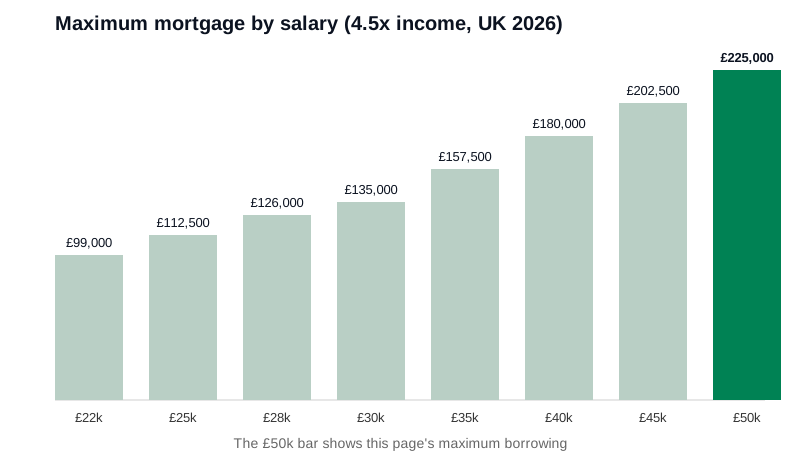
On £50,000 the band runs £200,000–£225,000, and the conversation shifts from "can I borrow" to "what structure". Stretch lenders at 5x reach toward £250,000; a partner’s £35,000 lifts a combined application past the £340,000 mark; and the deposit becomes the fastest lever — at this income, saving to the 25% loan-to-value tier often beats rushing in at 10%. The top-decile reality check is still worth writing down: the affordability model taxes lifestyle, and a high salary with high commitments borrows like a moderate salary with none. Buyers at this level win by walking in with a clean file, a deposit that crosses a rate tier, and a shortlist of properties priced inside the band rather than at its edge.
Frequently asked questions
How much mortgage can I get on a £50,000 salary?
£200,000–£225,000 from the mainstream multiples, with stretch deals toward £250,000 at 5x. Structure — deposit tier, term, commitments — decides more than the salary itself.
What mortgage can I afford on a £50,000 salary?
£200,000 of borrowing bills about £1,112 a month at 4.5% over 25 years. High salary with high commitments reads as a moderate salary with none — the model subtracts lifestyle.
How much mortgage can you get with a 50000 annual salary?
The standard quote is £200,000 (4x) to £225,000 (4.5x); the £250,000 tier belongs to stretch lenders and clean files.
What deposit do I need with a £50,000 salary?
On the 4x scenario (£222,222 property), 10% is £22,222 — but at this income, saving toward 25% crosses two rate tiers and beats rushing in at 10%.
What are the monthly payments on a £50,000 salary mortgage?
£200,000 over 25 years costs roughly £1,056 (4%), £1,112 (4.5%), £1,169 (5%) a month. A 35-year term or a crossed LTV tier moves the payment more than most rate-shopping.
Can a £50,000 salary borrow £250,000?
Yes, with the right lender — 5x stretch deals exist for higher earners with strong files. The standard band tops out around £225,000; the stretch tier demands more scrutiny on outgoings.
What does a £50,000 + £35,000 household borrow?
On £85,000 combined, the 4–4.5x band points to £340,000–£382,000 before commitments — the classic budget for a detached house in much of the country.
Is it better to save a bigger deposit or apply now at £50,000?
The honest math: crossing a loan-to-value tier (80%, then 75%) often improves the rate enough to beat a year of house-price drift — but only if the savings arrive faster than the market moves.
Related pages
- Mortgage calculator — payments on any loan size
- How much mortgage can I afford? — the full UK guide
- Average UK salary — see where £50,000 sits nationally
- Mortgage on a £22,000 salary
- Mortgage on a £25,000 salary
- Mortgage on a £28,000 salary
- Mortgage on a £30,000 salary
- Mortgage on a £35,000 salary
- Mortgage on a £40,000 salary
- Mortgage on a £45,000 salary