Mortgage borrowing on a £45,000 salary at a glance
| Income multiple | Max borrowing | Monthly payment (25yr, 4.5%) |
|---|---|---|
| 4x income (conservative) | £180,000 | £1,000 |
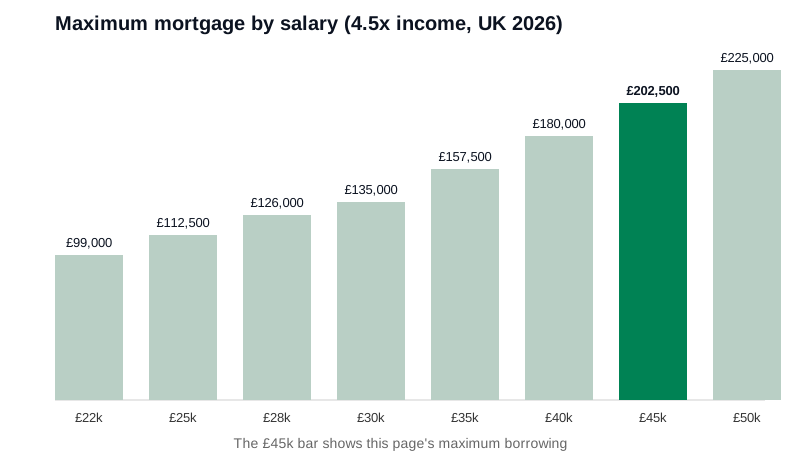
| 4.5x income (typical max) | £202,500 | £1,126 |
| 5x income (some lenders, higher earners) | £225,000 | £1,251 |
What that means in practice
Borrowing £180,000 at 4x income supports a property of about £200,000 with a 10% deposit of £20,000. Lenders check the monthly payment against your spending too, not just the multiple — at about £1,000 a month the payment sits near a third of a typical £45,000 take-home, which is inside most affordability models.
Monthly payments on £180,000 over 25 years: £950 at 4%, £1,000 at 4.5%, £1,052 at 5%. A bigger deposit moves you to a lower LTV band and cheaper rates. The MoneyHelper mortgage calculator is the official independent tool for checking affordability on gov-backed guidance.
What lenders actually check on a £45,000 salary
On £45,000 the check that decides the outcome is the debt-to-income ratio, read in the round: committed debts against gross salary, with most lenders comfortable below roughly 35–40% and sharp-pencil about anything above. The income itself gets its quality review — guaranteed components count in full, bonuses and commission need the twelve-month pattern, and a recent promotion counts only from the payslips that prove it. Lenders at this level also read the bank statements for stability signals: steady saving toward a deposit strengthens the file; large unexplained transfers or revolving overdraft use weaken it. Qualified professionals (medicine, law, accountancy, teaching and similar) unlock profession-specific lending at some banks — higher multiples against the same salary, priced on career trajectory — and a £45,000 file with clean credit and documented earnings is exactly the profile those schemes were designed for.
£45,000: the professional band, read like a lender
£45,000 produces a band of £180,000–£202,500, and at this level the binding constraint is rarely the multiple — it is the affordability stress test. Lenders model rates several points above today’s and ask whether the payment still clears the budget after childcare, commuting and committed debts. The professional-band playbook follows from that: cut committed spending before applying, not after; keep the credit utilisation low on every card; and time the application away from big new commitments. Two structural advantages also arrive at this income — eligibility for professional/profession-specific lending where offered, and a debt-to-income position strong enough that most high-street lenders quote from the top of the band rather than the middle.
Frequently asked questions
How much mortgage can I get on a £45,000 salary?
£180,000–£202,500 is the standard band on £45,000. The stress test decides the final figure — it models a higher rate and subtracts your committed spending.
What mortgage can I afford on a £45,000 salary?
£180,000 of borrowing costs about £1,000 a month at 4.5% over 25 years. Debt-to-income is the number that decides whether the lender agrees with the multiple.
How much mortgage can you get with a 45000 annual salary?
Expect £180,000 at 4x or £202,500 at 4.5x. Profession-specific schemes can quote higher multiples against the same salary for qualified careers.
What deposit do I need with a £45,000 salary?
The 4x case prices a £200,000 property — a £20,000 deposit at 10%. Credit utilisation below 30% across every card strengthens the file more than a few thousand extra.
What are the monthly payments on a £45,000 salary mortgage?
£180,000 over 25 years runs about £950 (4%), £1,000 (4.5%), £1,052 (5%) a month. Longer terms lower the payment the affordability model measures.
Why did my offer come in below £202,500 on a £45,000 salary?
Almost always commitments and dependants: childcare, car finance, student loans and credit cards each subtract from what the affordability model says you can sustain at a stressed rate.
Is a broker worth it at £45,000?
Often, yes — the differences between lenders compound fastest at this level, where one lender’s treatment of bonuses or a profession can move the band by £20,000.
Does a £45,000 salary plus bonus borrow on the bonus?
Usually only the guaranteed portion — or the lower of the guaranteed figure and a 12-month bonus average with employer evidence.
Related pages
- Mortgage calculator — payments on any loan size
- How much mortgage can I afford? — the full UK guide
- Average UK salary — see where £45,000 sits nationally
- Mortgage on a £22,000 salary
- Mortgage on a £25,000 salary
- Mortgage on a £28,000 salary
- Mortgage on a £30,000 salary
- Mortgage on a £35,000 salary
- Mortgage on a £40,000 salary
- Mortgage on a £50,000 salary