Mortgage borrowing on a £40,000 salary at a glance
| Income multiple | Max borrowing | Monthly payment (25yr, 4.5%) |
|---|---|---|
| 4x income (conservative) | £160,000 | £889 |
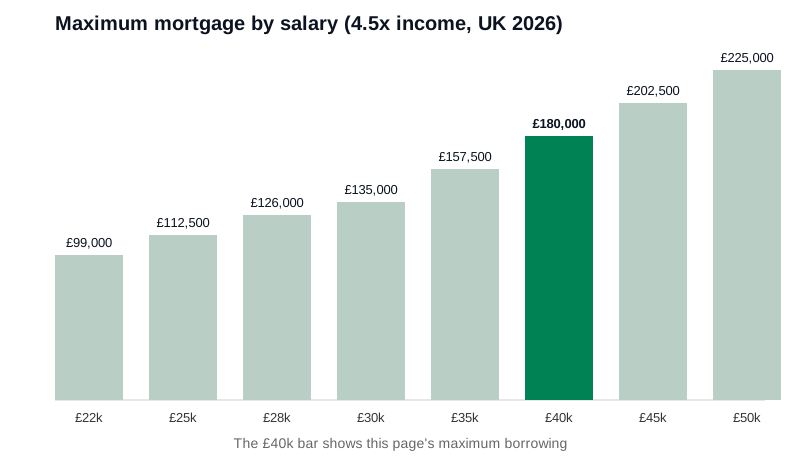
| 4.5x income (typical max) | £180,000 | £1,000 |
| 5x income (some lenders, higher earners) | £200,000 | £1,112 |
What that means in practice
Borrowing £160,000 at 4x income supports a property of about £177,778 with a 10% deposit of £17,778. Lenders check the monthly payment against your spending too, not just the multiple — at about £889 a month the payment sits near a third of a typical £40,000 take-home, which is inside most affordability models.
Monthly payments on £160,000 over 25 years: £845 at 4%, £889 at 4.5%, £935 at 5%. A bigger deposit moves you to a lower LTV band and cheaper rates. The MoneyHelper mortgage calculator is the official independent tool for checking affordability on gov-backed guidance.
What lenders actually check on a £40,000 salary
A £40,000 salary enters the stretch-lending conversation — and stretch lending brings scrutiny in proportion. Lenders offering 5x or more price the risk with tougher affordability modelling: a stress rate further above the quote, a lower tolerance for committed spending, and a hard look at how the salary is built (a £40,000 base is stronger than £34,000 plus an unpredictable £6,000 of overtime). The deposit also gets read differently at this level: crossing from 10% to 20% moves the loan-to-value a full pricing tier, which lowers the rate the stress test uses — meaning the bigger deposit improves the band twice, once on pricing and once on affordability. High-street lenders quote the standard band within a working day; the stretch quotes worth chasing are the ones a broker runs side by side on the same file.
£40,000: where stretch lenders start to matter
At £40,000 the standard band runs £160,000–£180,000, and a third door opens: income-stretch mortgages. Lenders that offer 5x or 5.5x multiples to higher earners, certain professions and strong deposit profiles can lift the ceiling toward £200,000–£220,000 — the level where three-bedroom houses in much of England stop being theoretical. The trade-off is scrutiny: stretch lending leans harder on the affordability check, on credit history and on outgoings, so the preparation that wins it is a clean file and low committed spending. For most £40,000 earners the pragmatic sequence is: quote from the standard band, negotiate on the property, and let a broker test the stretch lenders before settling.
Frequently asked questions
How much mortgage can I get on a £40,000 salary?
£40,000 unlocks £160,000–£180,000 at the standard multiples — and the stretch tier beyond: 5x deals reach toward £200,000 for strong files.
What mortgage can I afford on a £40,000 salary?
£160,000 of borrowing bills around £889 a month at 4.5% over 25 years. The stretch lenders stress that harder — scrutiny scales with the multiple.
How much mortgage can you get with a 40000 annual salary?
Mainstream is £160,000 (4x) to £180,000 (4.5x). Crossing £200,000 means income-stretch lending, profession schemes or a broker shopping the specialists.
What deposit do I need with a £40,000 salary?
A £177,778 property at 4x asks £17,778 for 10%. Twenty percent crosses the key LTV tier — pricing improves twice, on rate and on affordability.
What are the monthly payments on a £40,000 salary mortgage?
£160,000 over 25 years: about £845 at 4%, £889 at 4.5%, £935 at 5%. The deposit tier you land on decides which of those the lender actually uses.
Can I borrow more than 4.5x on a £40,000 salary?
Sometimes — some lenders offer 5x or more to higher earners, certain professions, or strong applications with large deposits. £200,000+ becomes possible, but the affordability check gets stricter, not looser.
What deposit turns £180,000 borrowing into a better deal?
15–20%. On a £225,000 purchase, borrowing £180,000 means a 20% stake — crossing below the 80% loan-to-value line usually improves the rate tier meaningfully.
Do joint applications on £40,000 + £40,000 double the band?
Close — the combined £80,000 typically points at £320,000–£360,000, which is why dual-earner households dominate the three-bed terraced market.
Related pages
- Mortgage calculator — payments on any loan size
- How much mortgage can I afford? — the full UK guide
- Average UK salary — see where £40,000 sits nationally
- Mortgage on a £22,000 salary
- Mortgage on a £25,000 salary
- Mortgage on a £28,000 salary
- Mortgage on a £30,000 salary
- Mortgage on a £35,000 salary
- Mortgage on a £45,000 salary
- Mortgage on a £50,000 salary