Mortgage borrowing on a £30,000 salary at a glance
| Income multiple | Max borrowing | Monthly payment (25yr, 4.5%) |
|---|---|---|
| 4x income (conservative) | £120,000 | £667 |
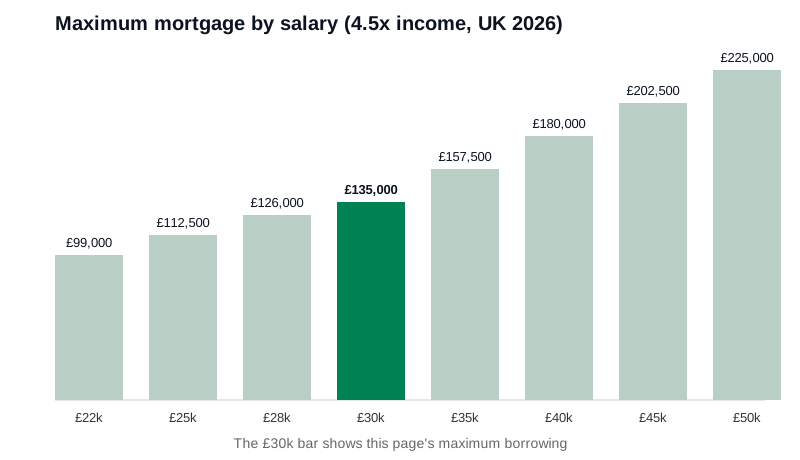
| 4.5x income (typical max) | £135,000 | £750 |
| 5x income (some lenders, higher earners) | £150,000 | £834 |
What that means in practice
Borrowing £120,000 at 4x income supports a property of about £133,333 with a 10% deposit of £13,333. Lenders check the monthly payment against your spending too, not just the multiple — at about £667 a month the payment sits near a third of a typical £30,000 take-home, which is inside most affordability models.
Monthly payments on £120,000 over 25 years: £633 at 4%, £667 at 4.5%, £702 at 5%. A bigger deposit moves you to a lower LTV band and cheaper rates. The MoneyHelper mortgage calculator is the official independent tool for checking affordability on gov-backed guidance.
What lenders actually check on a £30,000 salary
On £30,000 the affordability engine, not the income multiple, decides the final figure. Lenders start from the 4–4.5x band and then subtract: committed debts first (car finance is the classic band-killer — a £250 monthly payment can cut effective borrowing by around £15,000), then childcare, then the assessed maintenance of dependants. They stress-test the remainder at a notional rate well above the quote, and they verify the salary against three months of payslips plus the employment contract. Files that pass strongest at the benchmark salary share one habit: commitments cleared before applying. Settling a small loan six months ahead of an application adds more to the band than a raise that lands the month after submission — the lender only multiplies what the paperwork shows on the day.
£30,000: the benchmark salary, priced honestly
£30,000 is the salary every affordability conversation uses as its yardstick, and the band of £120,000–£135,000 is the honest answer it produces. Two levers decide how far toward the top of the band a real offer lands. The first is commitments: a £250 car finance payment can cut the effective band by £15,000 or more, because the lender subtracts committed spending before stress-testing. The second is the deposit: at 10% the rate improves enough to lower the monthly figure the affordability check measures, and at 15% the improvement compounds. Buyers at the benchmark salary should also apply with realistic geography — the band buys a first home outright in much of the country, a flat in the Midlands cities, and shared ownership in the South.
Frequently asked questions
How much mortgage can I get on a £30,000 salary?
The benchmark salary gets the benchmark band: £120,000–£135,000 at 4–4.5x. Where in that range you land depends almost entirely on your commitments, not your employer.
What mortgage can I afford on a £30,000 salary?
£120,000 of borrowing bills about £667 a month over 25 years at 4.5%. Clear the car finance first — a single £250 commitment can cost more band than a £2,000 raise.
How much mortgage can you get with a 30000 annual salary?
Around £135,000 at the common 4.5x multiple, or £120,000 at the conservative 4x. Bonus and overtime income counts only where twelve months of payslips prove it.
What deposit do I need with a £30,000 salary?
Ten percent on a £133,333 property (the 4x case) is £13,333. Crossing to 15% usually improves the rate tier enough to widen the affordability result.
What are the monthly payments on a £30,000 salary mortgage?
On £120,000 over 25 years: roughly £633 at 4%, £667 at 4.5%, £702 at 5%. The stress test prices you at the top of that range — plan for it.
Why would a lender offer £120,000 instead of £135,000 on £30,000?
Commitments and dependants. Car finance, credit cards, childcare and loans all reduce what the affordability calculation says you can sustain — the 4–4.5x band is the ceiling, not the promise.
Is £30,000 enough to buy in London?
Solo, almost never on the open market — the band buys shared ownership shares or requires a joint application. With a second £30,000 income, the combined band points at £240,000–£270,000.
Do lenders count overtime on a £30,000 salary?
Usually only if it is guaranteed or has a proven 12-month pattern — payslips plus employer confirmation convert variable earnings into income the lender will multiply.
Related pages
- Mortgage calculator — payments on any loan size
- How much mortgage can I afford? — the full UK guide
- Average UK salary — see where £30,000 sits nationally
- Mortgage on a £22,000 salary
- Mortgage on a £25,000 salary
- Mortgage on a £28,000 salary
- Mortgage on a £35,000 salary
- Mortgage on a £40,000 salary
- Mortgage on a £45,000 salary
- Mortgage on a £50,000 salary